|
 |
|
|
|
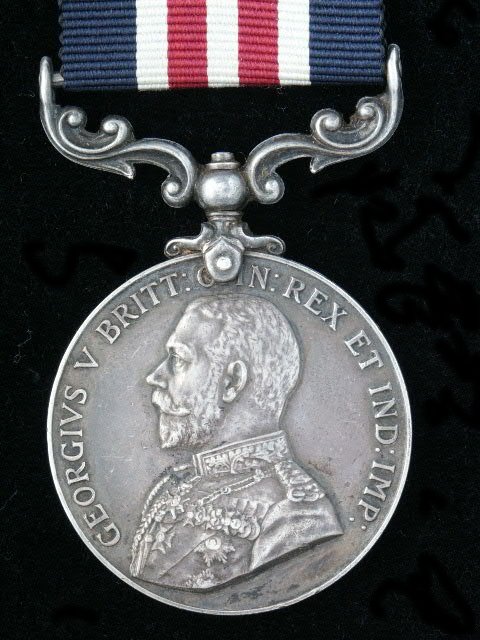
The Military Medal GV
Description: silver, 36mm diameter, with a swivelling suspension.
This gallantry award has been issued with six different obverses for
the three monarchs since its inception in 1916. Our illustrated example is the most
frequently encountered; that of King George the V, uncrowned, in
Field Marshal's uniform. The vast majority of this type were issued
for acts of bravery during the First Word War. The medal reverse
depicts the crowned royal cypher over the words "FOR BRAVERY IN THE
FIELD" all within a laurel wreath.
The Military Medal was instituted by Royal Warrant on the
25th March 1916 to be awarded for "acts of gallantry and devotion
to duty performed by non-commissioned officers and men of our
army in the field" 1.
Some retrospective awards were made. Women were included (by
an amendment of the 21st July 1916) whether British subjects or not
for "bravery and devotion under fire". A bar
was issued for subsequent awards and a silver rosette could be worn
when the ribbon alone was worn to denote the award of a bar. The
award of the Military Medal was announced officially in the London Gazette
hence this is the source for verification of this award. This "LG"
notification was generally published as a straightforward list of
names but
with the recipients home town included from September 1917.
Unfortunately the citation is not published, and the original
documentation recording citations has not survived
notes
1. Quoting the Royal Warrant -
Amended in 1920 to ""any of our military forces" and to include
allied armies.
2. Other commonwealth citations may be
recorded in the relevant countries archives, but for UK forces the
archives were
destroyed during the London Blitz in 1940. |
|
|
|
|
 |
 |
|
|
|
© copyright digitally watermarked / filigrane
numérique copyright © |
|
|
|
 |
|
482006. Sjt. A. Ardern. RE
49th Divisional Signal Company, Royal Engineers.
Announced in the London Gazette of the17th June 1919
(For France and Flanders)
Ardern was also Mention in Dispatches LG 18th May 1917 |
 |
41292 Cpl S. E. Milner
22nd Battalion Manchester Regiment.
Announced in the London Gazette of the
29th
March 1919.
(For Italy) |
 |
L-20135 Bmbr. H. Kavanagh.
"D" Battery, 36th Brigade, Royal Field Artillery
Announced in the London Gazette of the 23rd February 1918
(For France and Flanders) |
 |
3-8885 Pte. M. Bell.
1st Battalion West Yorkshire Regiment.
Announced in the London Gazette of the 13th March 1919
(For France and Flanders) |
 |
G-25168 L.Cpl R. C. Waller
1st Battalion the Queens Regiment (Royal West Surrey) attached
to the Machine Gun
Corps.
Announced in the London Gazette of the 29th August, 1918
(For France and Flanders) |
 |
|
240112 Cpl. G. E. Wilkinson
5th Battalion West Riding Regiment. (Duke of Wellington's)
Award announced in the London Gazette of the18th October
1917
(For France and Flanders)
Serjeant George Emsley Wilkinson, died of wounds in July 1918
- he was the son of
R.A. and Jane Wilkinson of
"Park View", Kirkburton Huddersfield.
He is Buried in the Vertus Communal Cemetery, Marne, France. |
|
|
|
|
|
Guide to British Medals
Index Page |
Site Home Page |
|
|
|
|
© This website and its contents are copyright. Images are digitally watermarked All Rights Reserved.
© |
|
|
|
|
|